
Our Engineering Approach
Safety, efficiency, architectural integrity and sustainability are not the result of one access technique. They are the result of a complete engineering process.
We Design How Maintenance Gets Done
The value is not limited to solving extraordinary problems. The same rigorous method improves everyday maintenance and makes exceptional operations possible.
Every maintenance operation is the result of decisions made during analysis, design, manufacturing, installation and use. Our role is to engineer those decisions so the operation becomes safer, more efficient and compatible with the architecture.
Five Principles
The homepage introduces the principles. Here each one is connected to its design focus and operating result.
01Safety
Access, progression, positioning, rescue, evacuation and emergency management are considered from the earliest stages.
- Design focus
- Reduce complexity and validate risk assumptions.
- Result
- Safer, more controlled operations.
02Efficiency
Routes, anchors, lifting operations and replacement sequences are coordinated as one operating workflow.
- Design focus
- Reduce movements, time and resource use.
- Result
- Faster, more predictable maintenance.
03Architectural Integrity
Geometry, materials, finishes and colours are coordinated to minimize technical interference.
- Design focus
- Integrate or conceal permanent devices wherever possible.
- Result
- Maintenance systems that protect the architectural vision.
04Simplicity
Additional components and interfaces increase the possibility of error, delay and system failure.
- Design focus
- Eliminate what is unnecessary through rigorous engineering.
- Result
- Intuitive, reliable systems that are easier to operate.
05Maintainability
A building must be inspectable, cleanable, repairable and adaptable throughout its useful life.
- Design focus
- Plan repeated intervention and lifecycle change.
- Result
- Long-term architectural and economic value.
From Strategy to Lifecycle Support
Understand
Preliminary access strategy, geometry, environmental behaviour, building-specific requirements and lifecycle priorities.
Design
Access layouts, structural coordination, anchors, loads, rescue strategy, CAD, FEA and custom equipment engineering.
Construction
Construction drawings, manufacturing, assembly, laboratory testing, functional validation and long-term preservation.
Control
Installation documentation, supervision of third parties, site inspections, commissioning and compliance verification.
Handover
O&M manuals, as-built records, digital documentation, training and lifecycle operating support.
Engineering Begins Before the Layout
The maintenance strategy is defined around the real building, its environment and its use.
Environmental Behaviour
Wind, pollution patterns, exposure, climate and site-specific operating windows.
Building-Specific Features
Geometry, façade systems, roofs, landscaping, photovoltaic systems and technical plants.
Operational Requirements
Building use, intervention frequency, access restrictions, operator movement and business continuity.
Lifecycle Assessment
Recurring cost, inspection cycles, replacement logic and long-term asset performance.
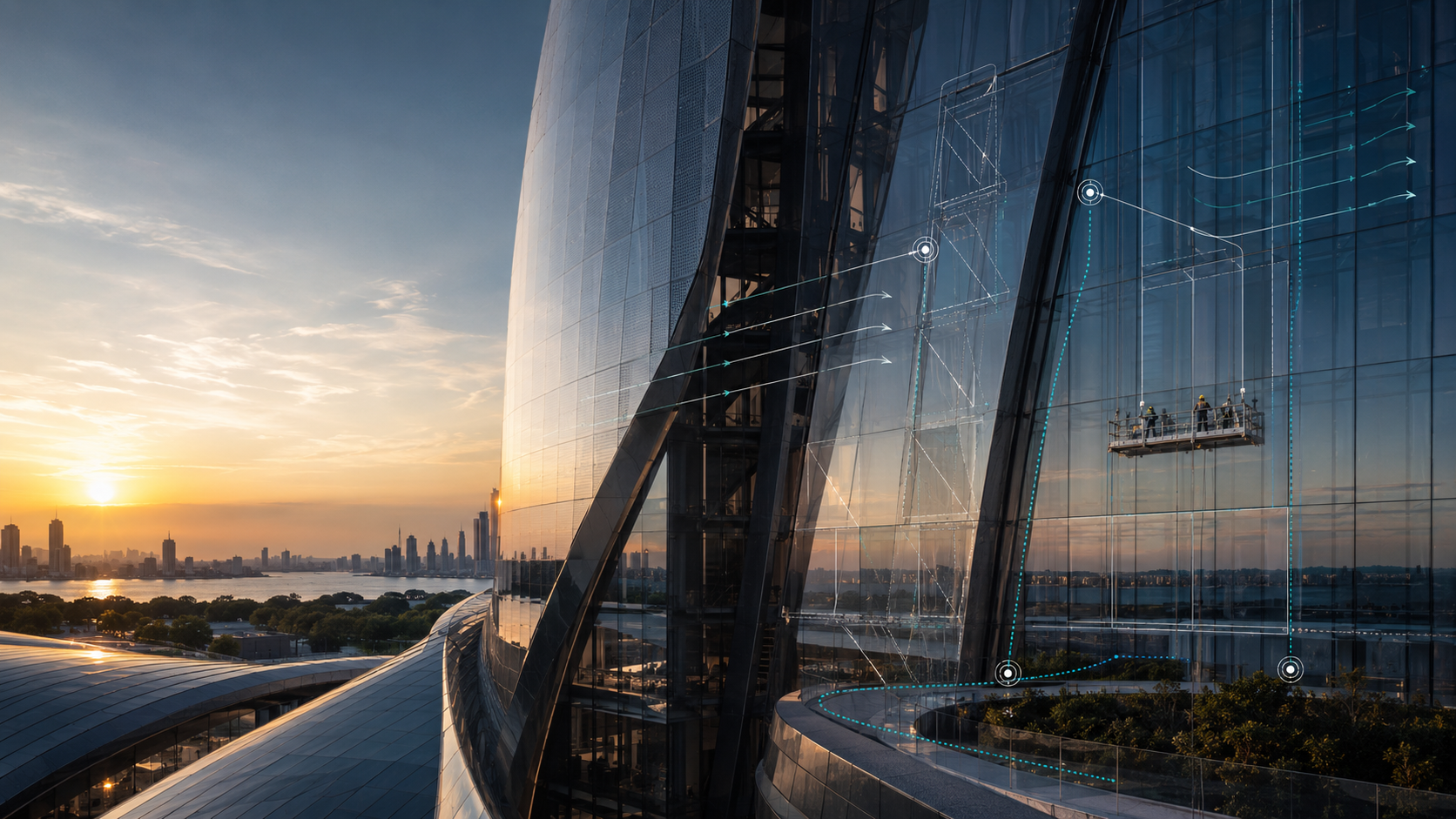
From Sketch to Validated System
More Than Documentation
Installation Process
Installations may be performed by other parties. Fly Service Engineering provides drawings, procedures, interfaces, inspections and commissioning support so systems are installed as engineered.
Controls & Validation
Design reviews, calculations, prototype tests, production checks, site supervision and final verification maintain the required quality standard throughout the project.
Certification Support
Technical documentation, test procedures and assistance are prepared in accordance with the applicable standards and certification pathway.
Scope & Responsibility
Deliverables define assumptions, interfaces, installation responsibilities, inspection requirements, rescue conditions and system limitations.
Handbook & Digital Records
Operating instructions, safe access methods, inspection schedules, maintenance procedures, emergency strategies and as-built information.
Training & Lifecycle Support
Training for operators, facility managers and maintenance teams enables safe, efficient and compliant use over time.
The True Cost Is Measured Over Decades
Decisions made during design influence safety, cost, sustainability and building value throughout its useful life.
Designing maintainability into the asset can reduce inefficient practices, avoid unnecessary permanent systems, improve intervention predictability and support longer-term architectural performance.
Engineer the Maintenance Strategy Early.
Our team can support the project from preliminary analysis through design, validation, control and handover.